


Weighing up CCNA vs the other IT courses available through IT Courses Australia is one of the most common questions we hear from people starting an IT career in 2026. Networking, cybersecurity, cloud, data analytics, IT support, and software development all lead to genuinely different jobs, salaries, and day-to-day work – so the right starting point depends on your goals, not just which course sounds most in-demand. This guide breaks down how CCNA compares to the other main IT course paths so you can choose with confidence.
What Is CCNA and Who It’s For
CCNA (Cisco Certified Network Associate) is the industry-standard entry certification for networking careers, covering routing, switching, IP addressing, and network security fundamentals. It suits people who enjoy working with physical and virtual infrastructure – the systems that keep data moving between offices, data centres, and the cloud – and it’s often the first step toward network engineer, network administrator, or later network security roles.
Other IT Course Paths at IT Courses Australia
Cybersecurity Certifications (Security+, CySA+, PenTest+)
Cybersecurity courses suit people interested in defending systems, investigating incidents, or – further down the track – ethical hacking. Entry-level roles typically start as SOC analyst or junior security analyst positions, with strong long-term demand as organisations continue to invest in security.
Cloud Certifications (AZ-900, AWS Cloud Practitioner)
Cloud courses are a strong fit for beginners who want exposure to modern infrastructure without needing a networking or coding background first. They’re commonly used as a stepping stone toward cloud engineering, DevOps, or cloud security roles, and pair well with either a CCNA or software development background later on.
Data Analytics & SQL
Data-focused courses suit people who enjoy working with numbers, trends, and business reporting rather than infrastructure. SQL is the core skill here, often paired with Power BI or Tableau, and leads toward data analyst or reporting analyst roles across almost every industry.
IT Support / Help Desk
Help desk and IT support courses are often the fastest, lowest-cost entry point into the IT industry, and commonly serve as a launching pad into networking, cybersecurity, or cloud specialisations once you’ve built up some workplace experience.
Software Development
Coding-focused courses suit people who want to build applications and systems rather than manage infrastructure. It typically requires more upfront study time than the other paths on this list, but often leads to a wider range of remote and higher-paying roles over the long term.
CCNA vs Other IT Courses: Quick Comparison
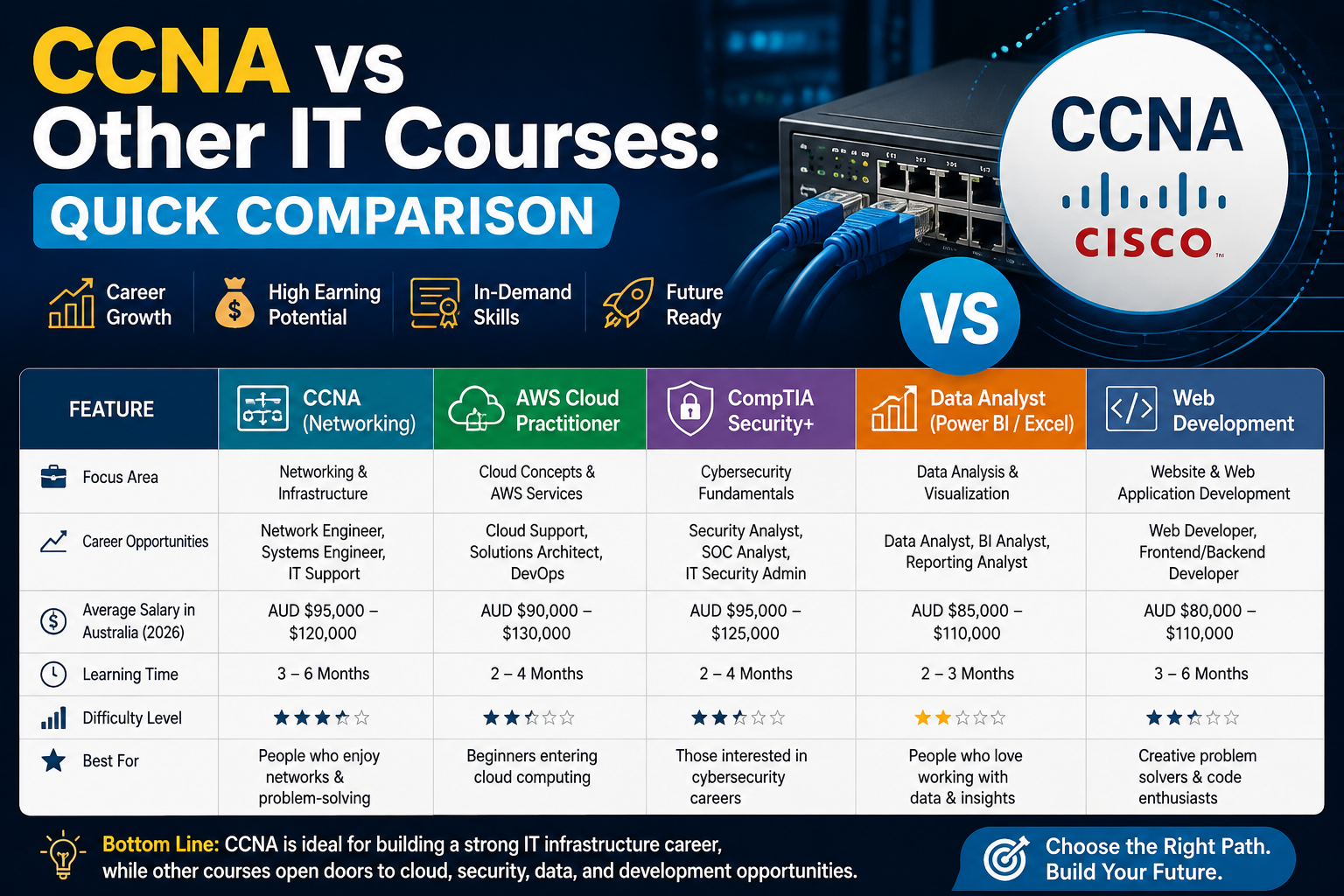
| Course Path | Typical Entry Role | Study Time | Indicative Entry Salary* |
| CCNA (Networking) | Junior Network Engineer | 2-4 months | $65,000 – $85,000 |
| Security+ / Cybersecurity | SOC Analyst | 2-3 months | $70,000 – $100,000 |
| AZ-900 / AWS Cloud | Junior Cloud Support | 3-6 weeks | $65,000 – $90,000 |
| SQL / Data Analytics | Junior Data Analyst | 2-4 months | $65,000 – $90,000 |
| IT Support / Help Desk | Service Desk Analyst | 4-8 weeks | $55,000 – $75,000 |
| Software Development | Junior Developer | 4-9 months | $70,000 – $95,000 |
*Indicative entry-level ranges compiled from multiple Australian salary-data sources as of mid-2026. Actual pay varies by city, employer, and prior experience.
Which IT Course Path Pays the Most in Australia? *
At entry level, the differences between these paths are smaller than most people expect – the bigger salary gaps open up two to five years in, once you specialise. Software development and cybersecurity tend to have the highest long-term salary ceilings, cloud and networking sit in the middle with strong demand and steady progression, and IT support offers the fastest, cheapest entry but typically the lowest starting pay – though it’s an excellent stepping stone into any of the other paths once you’ve got workplace experience.
Which IT Course Is Easiest for Beginners?
- Easiest to start: IT Support/Help Desk and cloud fundamentals (AZ-900/AWS Cloud Practitioner) – both are designed for complete beginners.
- Moderate: CCNA and Security+ – both assume no prior experience but require more structured study time.
- More demanding: Software development and data analytics – both benefit from a logical, problem-solving mindset and generally take longer to become job-ready.
IT Job Market in Australia by City
- Sydney and Melbourne – the largest volume of roles across every path, particularly finance, banking, and enterprise IT
- Canberra – strong demand for networking, cybersecurity, and cloud roles tied to government and defence
- Brisbane – growing demand across cloud and cybersecurity, tied to infrastructure and government digital transformation
- Perth – resources and energy sector demand for networking and cloud migration skills
- Adelaide – defence industry demand for cybersecurity and networking roles
Listings on Seek show steady demand for all six of these course paths across every major Australian city, though the exact mix shifts depending on local industry – finance-heavy cities lean toward cybersecurity and data analytics, while resources and government hubs lean toward networking and cloud.
How to Choose the Right IT Course for You in 2026 *
- Enjoy hands-on infrastructure and troubleshooting? Start with CCNA.
- Interested in defending systems or investigating incidents? Start with Security+ or CySA+.
- Want the fastest, lowest-cost entry into IT? Start with IT Support/Help Desk.
- Curious about modern infrastructure without a networking background? Start with AZ-900 or AWS Cloud Practitioner.
- Enjoy numbers, trends, and business reporting? Start with SQL and data analytics.
- Want to build applications rather than manage infrastructure? Start with software development.
Many Australian IT professionals combine two or more of these over time – for example, starting with IT Support, adding CCNA within the first year, and layering on a security or cloud certification once they’ve found their specialisation.
Where to Study IT Courses in Australia
If you’d rather follow a structured study plan than piece it together from scattered free resources, IT Courses Australia runs beginner-to-advanced training across CCNA, cybersecurity, cloud, data analytics, IT support, and software development – all built around real Australian workplace scenarios.
Explore the CCNA course pathway, compare it with the cybersecurity certification pathway or the cloud certification pathway, or browse the full course library to see every path covered in this guide side by side.
Frequently Asked Questions
Is CCNA still a good starting point for IT in 2026?
Yes – networking fundamentals remain relevant even as more infrastructure moves to the cloud, and CCNA is still widely requested for junior network engineer and network support roles across Australia.
Should I start with IT Support before doing CCNA or Security+?
It’s a common and reasonable path – IT Support roles are faster to enter and give you real workplace experience that makes specialised certifications like CCNA or Security+ easier to apply once you’ve completed them.
Can I do more than one course path at IT Courses Australia?
Yes – many learners combine paths over time, such as pairing CCNA with a cybersecurity or cloud certification once they’ve established their networking fundamentals.
Which course path has the fastest job placement after finishing?
IT Support and cloud fundamentals tend to have the shortest study time and can lead to faster initial job placement, though CCNA and Security+ often lead to roles with stronger long-term salary growth.
Final Thoughts
So, CCNA vs the other IT courses at IT Courses Australia – which should you choose in 2026? If you’re drawn to infrastructure and troubleshooting, CCNA is a strong, well-recognised starting point. If a different path – cybersecurity, cloud, data analytics, IT support, or software development – fits your interests better, that’s just as valid a route into a solid Australian IT career. Whichever direction you’re leaning, explore the full range of IT courses and start building the path that matches your goals.