


Is CCNA certification worth it in Australia is one of the most common questions among aspiring network engineers and IT professionals. For anyone wanting a networking or IT infrastructure career, CCNA remains one of the highest-ROI entry-level IT certifications in the Australian job market. However, the real answer depends on your career stage, the course cost you pay, and how quickly you can convert the certification into a networking job.
This guide breaks down CCNA certification salary in Australia, real job demand, total cost in 2026, and how it compares to alternatives so you can decide with real numbers instead of guesswork.
What Is CCNA Certification and Why Does It Matter in Australia?
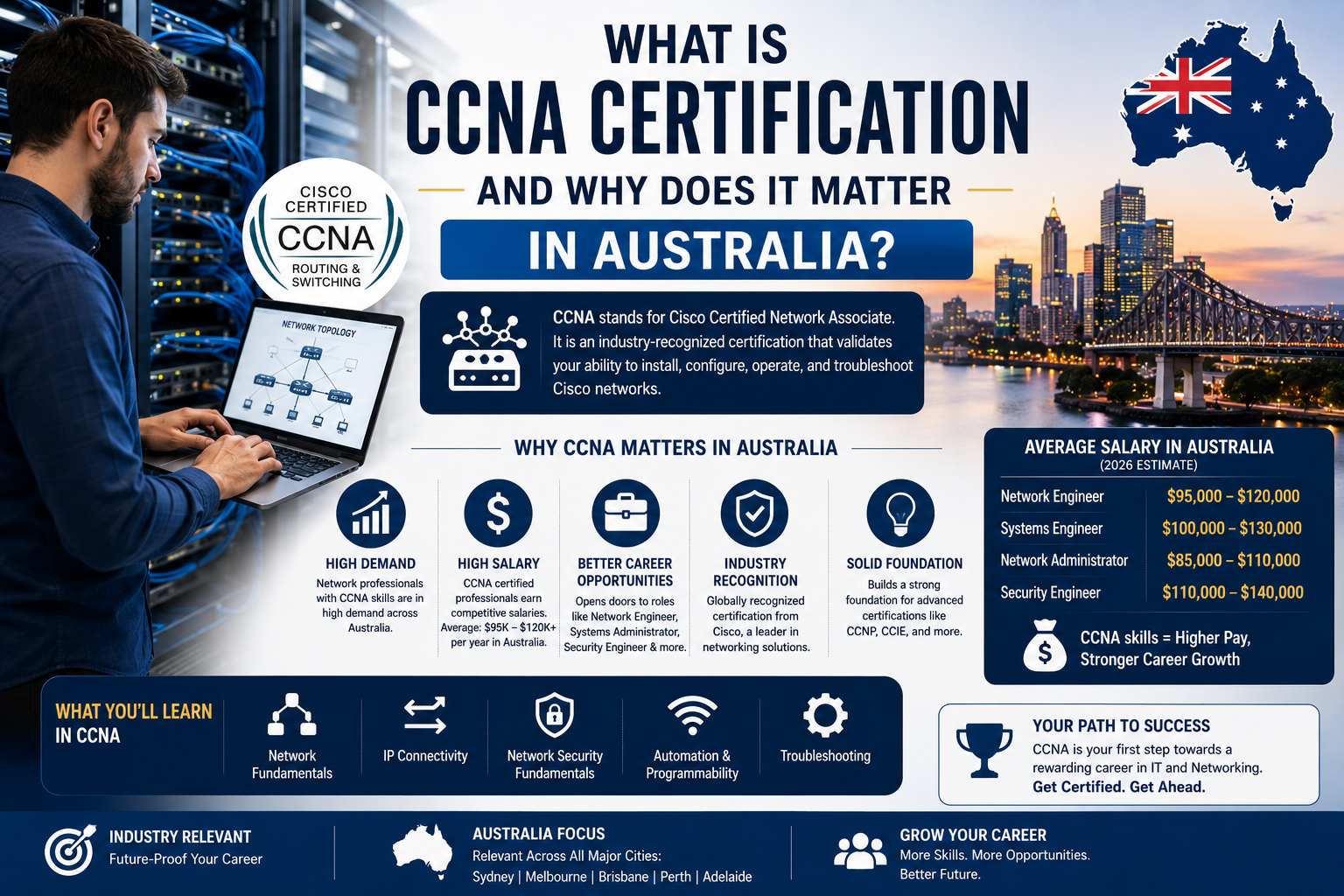
CCNA (Cisco Certified Network Associate) is an entry-to-associate level networking certification covering IP networking, security fundamentals, automation, and network access. In Australia, CCNA certification is widely recognised by employers hiring for network administrator, help desk engineer, and junior network engineer roles making it one of the most searched-for IT certifications among career switchers and IT graduates.
Is CCNA Certification Worth It? The Case For Yes
- Vendor-neutral networking fundamentals employers trust across every industry
- Opens doors to network administrator, NOC analyst, and support engineer roles
- Recognised pathway into higher Cisco certifications (CCNP, CCIE) later in your career
- Strong return relative to course cost most candidates recover the investment within their first CCNA-related pay rise
CCNA Certification Salary in Australia (2026)
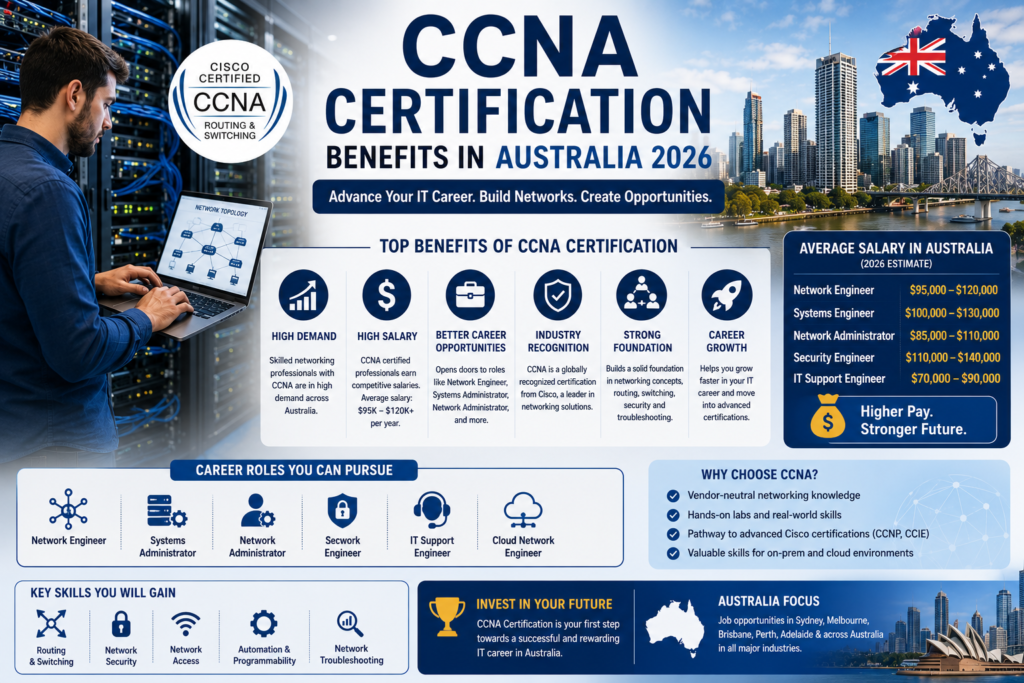
CCNA certification salary in Australia varies by role, location, and experience. Here’s what CCNA-certified professionals typically earn across common entry and mid-level networking roles in 2026:
| Role | Typical Salary Range (AUD) | Experience Level |
| Network Administrator | $65,000 – $85,000 | Entry–2 yrs |
| Junior Network Engineer | $70,000 – $90,000 | 1–3 yrs |
| Network Support Engineer | $75,000 – $95,000 | 2–4 yrs |
| Network Engineer (CCNA+exp) | $90,000 – $115,000 | 3–5 yrs |
| Senior Network Engineer | $115,000 – $140,000+ | 5+ yrs (often CCNP) |
Figures are indicative national averages for 2026 and vary by city, industry, and employer. Sydney and Melbourne generally sit at the higher end; regional roles and smaller Brisbane, Perth, and Adelaide employers can sit slightly lower but often come with less competition.
CCNA Jobs in Australia: Real Demand in 2026
CCNA jobs in Australia remain consistently listed across Seek, LinkedIn, and Indeed under network administrator, network support, and infrastructure engineer postings. Sectors hiring CCNA-certified staff include:
- Managed service providers (MSPs) and IT consultancies
- Telecommunications and ISPs
- Banking, finance, and healthcare IT infrastructure teams
- Government departments and defence contractors requiring network security clearance
- Cloud and data centre operators expanding hybrid on-prem/cloud networking
How Much Does CCNA Certification Cost in Australia (2026)?
CCNA certification cost in Australia includes the exam fee plus training. Here’s a realistic 2026 breakdown:
| Cost Item | Typical Price (AUD) |
| Official Cisco exam fee (200-301) | ~$395 – $470 |
| Self-study materials only | $100 – $400 |
| Instructor-led training course | $1,500 – $3,500 |
| Retake exam fee (if needed) | ~$395 – $470 |
| Total realistic budget (course + exam) | $1,900 – $4,000 |
Is CCNA Certification Worth the Cost? ROI Breakdown
Against an average entry salary uplift of $10,000–$20,000 once certified and employed in a networking role, most candidates recover their CCNA course cost within the first 3–6 months of a new or upgraded role. That makes CCNA certification one of the better ROI plays among Australian IT certifications compared to broader, more expensive cloud certification tracks that assume prior networking knowledge.
CCNA vs Other Entry-Level IT Certifications in Australia
- CCNA vs CompTIA Network+: CCNA carries more employer recognition for dedicated networking roles; Network+ is a lighter, vendor-neutral starting point
- CCNA vs AZ-900: AZ-900 suits cloud-first career paths; CCNA suits infrastructure, on-prem, and hybrid networking paths
- CCNA vs CCNP: CCNP is the logical next step after 2–3 years of CCNA-level experience, not a starting point
Who Should Get CCNA Certified in Australia?
- IT graduates wanting a clear entry point into networking careers
- Help desk and support staff looking to move into infrastructure roles
- Career changers targeting stable, in-demand technical roles
- Existing IT professionals formalising practical networking experience
Is CCNA Certification Worth It in Australia? The Verdict
For most people targeting a networking or infrastructure career, CCNA certification is worth it in Australia in 2026 the salary uplift, job demand across MSPs, telcos, and enterprise IT teams, and manageable course cost make it one of the strongest entry-level IT certification investments available. The main condition: pair the certification with hands-on lab practice, since employers increasingly test applied networking skills at interview, not just the certificate.
Industry Data Backing the CCNA Career Path
This aligns with broader IT skills-shortage reporting from the Australian Computer Society’s Digital Pulse report and global certification-value research published by CompTIA’s IT industry outlook, both of which identify networking and infrastructure skills as consistently in-demand across the Australian technology workforce.
Train for CCNA Certification with Logitrain (Australia-Wide)
Logitrain delivers instructor-led CCNA training across Australia, with structured exam preparation and hands-on labs. Explore related course and city pages:
- CCNA Certification Course
- Networking Fundamentals Course
- Cyber Security Certifications
- Azure Certifications (cloud pathway)
CCNA Training Available Across Major Australian Cities
CCNA certification training and exam demand span every major Australian city. Related city hub pages:
- CCNA Training Sydney
- CCNA Training Melbourne
- CCNA Training Brisbane
- CCNA Training Perth
- CCNA Training Adelaide
- CCNA Training Canberra
Frequently Asked Questions
Is CCNA certification worth it for beginners in Australia?
Yes — CCNA is designed as an associate-level entry point and doesn’t require prior networking certification, making it a practical first step into IT infrastructure careers.
How long does it take to get CCNA certified in Australia?
Most candidates complete CCNA preparation in 3–6 months with structured instructor-led training, or longer with self-paced study alongside full-time work.
What salary can I expect with CCNA certification in Australia?
Entry-level CCNA-certified roles typically start between $65,000–$85,000, rising toward $90,000–$115,000+ with a few years of applied networking experience.
Does CCNA certification expire?
Yes Cisco certifications are valid for 3 years, after which recertification or progression to CCNP is required to keep the credential current.
Ready to start?
Explore CCNA and IT certification courses at itcourses.au and see current course dates, pricing, and delivery options.