


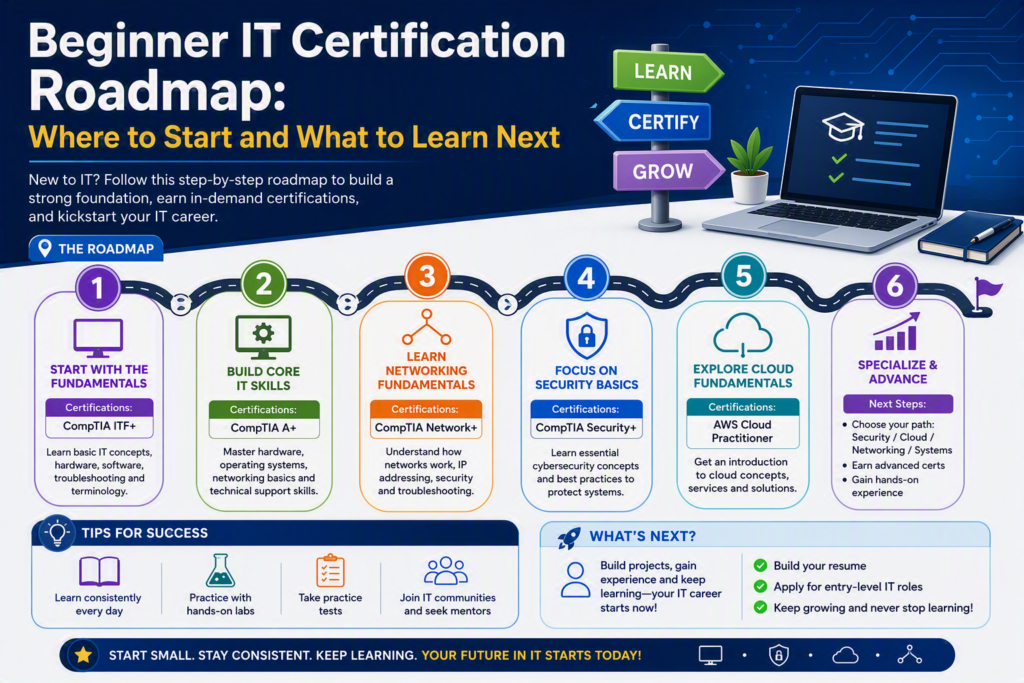

Googling “which IT certification should I get first” usually leads to more confusion, not less every forum thread recommends something different. This beginner IT certification roadmap cuts through the noise with a clear, sequential path for 2026: what to study first, what comes next, and how each certification connects to an actual entry-level IT job in Australia.
Whatever direction you eventually want to specialise in networking, cybersecurity, cloud, or systems administration every reliable beginner IT certification roadmap starts in the same place: IT fundamentals. From there, the path splits based on your goals.
Step 1: Start With Foundational IT Certifications
Before specialising, every beginner benefits from building a base in core IT concepts hardware, operating systems, networking basics, and troubleshooting. These are the most common starting certifications in Australia in 2026:
| Certification | Covers | Study Time | Cost (AUD) |
| CompTIA ITF+ | Absolute IT basics | 2–3 weeks | ≈ $130 |
| CompTIA A+ | Hardware, OS, troubleshooting | 6–10 weeks | ≈ $460 (2 exams) |
| CompTIA Network+ | Networking fundamentals | 4–8 weeks | ≈ $370 |
| AZ-900 or AWS Cloud Practitioner | Cloud fundamentals | 3–5 weeks | ≈ $130–150 |
If you’re completely new to IT, CompTIA A+ is the most widely recommended first step in any beginner IT certification roadmap it’s broad, practical, and directly recognised by Australian employers hiring for help desk and IT support roles.
Step 2: Choose Your Specialisation Direction
Once you’ve covered the fundamentals, the roadmap branches based on the kind of IT career you want. Here’s how each direction typically progresses:
| Career Direction | Next Certifications | Typical First Role |
| IT Support / Sysadmin | CompTIA A+ → Network+ → Server+ | Help Desk / IT Support Technician |
| Networking | Network+ → Cisco CCNA | Junior Network Technician |
| Cybersecurity | Network+ → Security+ → SC-900 | SOC Analyst Level 1 |
| Cloud | AZ-900 → AZ-104 or AWS Cloud Practitioner → Solutions Architect Associate | Junior Cloud Support Engineer |
| Systems / DevOps | Network+ → Linux+ → cloud platform cert | Junior Systems Administrator |
You don’t need to lock in a direction immediately many people complete CompTIA A+ and Network+ before deciding whether cybersecurity, cloud, or networking is the better long-term fit.
What Order Should You Learn IT Certifications In?
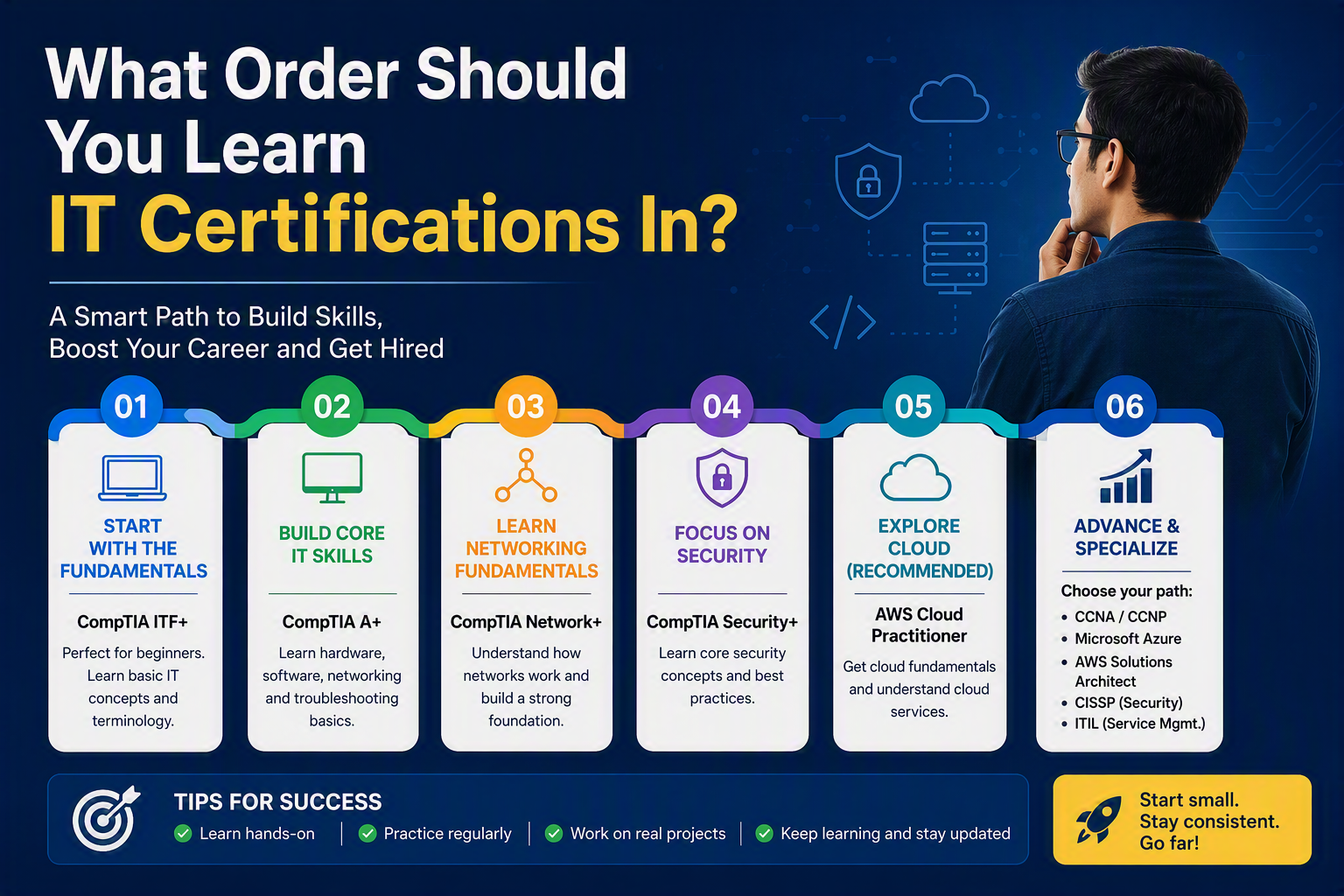
- Start broad — ITF+ or A+ before anything specialised.
- Add networking fundamentals next — Network+ underpins almost every IT specialisation.
- Branch into your chosen direction — Security+, cloud fundamentals, or Cisco CCNA.
- Apply for entry-level roles once you’ve completed 1–2 certifications, rather than waiting until you’ve completed the entire roadmap.
A common mistake in a self-planned beginner IT certification roadmap is trying to earn four or five certifications before applying for any jobs. Most Australian employers hire help desk and junior support staff with just one or two foundational certifications, then support further study on the job.
Beginner IT Job Demand by Australian City
Entry-level IT support and help desk roles are available nationwide, but demand and starting salaries vary by city. Job markets are strongest in Sydney and Melbourne, while Canberra offers strong opportunities in government IT support, and Brisbane and Perth continue to see steady growth in corporate and resources-sector IT teams.
How Long Does a Beginner IT Certification Roadmap Take?
Most people complete their first two certifications typically A+ and Network+ within 3 to 6 months of part-time study, and land their first help desk or IT support role shortly after. Reaching a specialised mid-level role (network engineer, SOC analyst, cloud support) generally takes an additional 12 to 24 months of on-the-job experience layered on top of further certifications.
Common Mistakes to Avoid on Your IT Certification Roadmap
- Trying to study multiple unrelated certifications at once instead of following a sequence.
- Skipping networking fundamentals and jumping straight into security or cloud certifications.
- Waiting to apply for jobs until you feel “fully ready” rather than after your first certification.
- Choosing a specialisation based on hype rather than the job ads in your own city.
If you’d rather follow a structured, guided path instead of piecing your roadmap together from forum advice, our beginner IT certification course at itcourses.au walks you through foundational certifications with hands-on labs, then helps you choose and prepare for the right next step.
Frequently Asked Questions
What is the best first IT certification for beginners?
CompTIA A+ is the most widely recommended starting point in Australia, covering hardware, operating systems, and troubleshooting skills employers expect for help desk roles.
Do I need a degree to follow an IT certification roadmap?
No. Many Australian IT professionals build successful careers through certifications and hands-on experience alone, without a university degree.
How many certifications do I need before applying for IT jobs?
Most beginners can apply for entry-level help desk or IT support roles after just one or two foundational certifications, such as A+ and Network+.
Should I choose cybersecurity, cloud, or networking first?
Start with foundational certifications like A+ and Network+, which apply to all three paths, then choose your specialisation based on the job ads and interests in your target city.
How much does a beginner IT certification roadmap cost in total?
Foundational certifications typically cost between $130 and $460 AUD each, so a first-stage roadmap of two certifications usually totals $500–$900 AUD.
Final Thoughts
A good beginner IT certification roadmap isn’t about collecting as many certifications as possible it’s about building a foundation, applying for your first role early, and specialising once you know what direction genuinely interests you.
Ready to start your roadmap the right way? Explore current course intakes at itcourses.au and take the first step toward your first IT role.