


SQL database training Australia searches spike every year from two groups: career-changers looking for a fast, practical way into tech, and existing IT, data, or business professionals who know SQL is the one skill showing up in almost every job ad they read. Short answer: yes, for most people it’s worth it SQL is one of the cheapest technical skills to learn relative to the salary it unlocks, and it rarely goes out of date. “Worth it” still depends on which training path you choose and what role you’re aiming for.
This guide breaks down what SQL database training Australia actually costs in 2026, what SQL-related roles pay by experience and city, and a realistic, step-by-step path to turn the training into a job.
What Is SQL Database Training, and Who Needs It?
SQL (Structured Query Language) is the standard language for querying, updating, and managing relational databases — the systems that store almost everything a business runs on, from customer records to financial transactions. SQL database training typically covers:
- Core querying: SELECT statements, filtering, sorting, and aggregating data
- Joins and subqueries for combining data across multiple tables
- Database design fundamentals: tables, keys, relationships, normalisation
- Data manipulation: INSERT, UPDATE, DELETE, and transaction handling
- Platform-specific skills on Microsoft SQL Server, MySQL, PostgreSQL, or Azure SQL
It’s genuinely one of the more accessible technical skills to learn no prior coding background is required for the fundamentals, and most beginners are writing useful queries within the first few sessions.
For official course listings and self-paced options, see the TAFE NSW SQL and database training page.
SQL Database Training Australia: What It Actually Costs
SQL database training Australia costs vary enormously depending on how deep you want to go and whether you need a formal credential or just practical skills. Here’s a realistic breakdown.
| Training Option | Typical Cost (AUD) |
| TAFE short course / Microskill (self-paced, e.g. Intro to SQL) | $50–$300 |
| TAFE certificate/diploma unit including SQL/databases | $660–$2,640 per semester (concession rates vary) |
| Private instructor-led SQL course (1–3 day, e.g. SQL Essentials) | $600–$1,200 per course |
| Bundled SQL course package (Essentials + Advanced) | Around $2,000–$2,200 (bundle discounts common) |
| Multi-day vendor-recognised SQL training program | From around $2,995 |
| Self-paced online SQL course (Udemy, Coursera, DataCamp style) | $0–$50/month or one-off $20–$200 |
For most career-changers, the sweet spot is a low-cost TAFE short course or a $600–$1,200 instructor-led course enough structure to learn properly without the cost of a full diploma. A formal diploma or degree unit is worth it only if you want a broader IT qualification alongside the SQL skill itself.
SQL Database Training Australia: What the Skill Pays
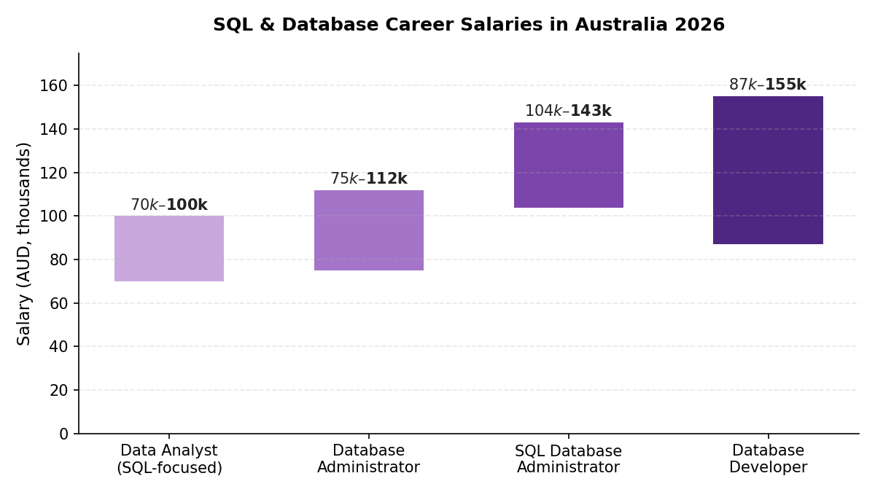
SQL database training Australia data shows the return on investment is unusually strong a few hundred dollars in training against roles regularly paying six figures. Here’s how the numbers break down by role.
| Role | Average / Range (AUD) |
| SQL (general, all roles using SQL as core skill) | Average $155,000/yr; range $124,030–$198,752 |
| Database Administrator (national average) | Average $93,600/yr; entry $56,160–$74,880; senior $112,320–$168,480 |
| SQL Database Administrator (national) | Average $120,062/yr; typical range $104,464–$143,161 |
| SQL Database Administrator (Sydney) | Average $142,890/yr; entry-level (1–3 yrs) $100,611; senior (8+ yrs) $162,861 |
| Database Developer (national) | Average $126,677/yr; range $87,407–$154,546 |
| SQL Data Analyst (Melbourne) | Average $116,774/yr; entry-level $82,222; senior (8+ yrs) $133,025 |
| Database Administrator, DBA (PayScale, broader sample) | Average $75,145/yr; entry-level under 1 yr $54,045 |
Pulling these together, a realistic range for SQL-skilled roles in Australia in 2026 looks like:
- Entry-level (0–3 years): $54,000–$100,000 depending on role and city
- Mid-level (3–6 years): $90,000–$130,000
- Senior (7+ years): $130,000–$165,000+
- SQL Database Administrator, Sydney specifically: averages around $143,000, among the highest in the country
Even outside dedicated database roles, SQL is a résumé multiplier Business Analysts, Data Analysts, and even Marketing Analysts who add solid SQL skills routinely report $10,000–$15,000 higher offers than peers without it.
SQL Database Training Australia: Salary by City
Demand and pay aren’t even across the country. Sydney carries both the largest volume of database and SQL-heavy roles and the highest average pay, driven by financial services and enterprise IT. Melbourne is a close second with a strong analytics and data engineering scene.
For a live view of current openings and advertised pay by role, see SEEK Career Advice: Database Administrator salary (dofollow, external source).
Sydney SQL & Database roles — the highest-paying market nationally, financial services and enterprise IT driving demand. View Sydney courses
Melbourne SQL & Database roles — strong analytics and data engineering demand, comparable pay to Sydney for mid-to-senior roles. View Melbourne courses
Brisbane SQL & Database roles — growing steadily, slightly below Sydney/Melbourne averages but lower cost of living. View Brisbane courses
Perth SQL & Database roles — resources-sector data and reporting roles, steady demand. View Perth courses
Adelaide SQL & Database roles — defence and government-adjacent data roles, smaller volume but stable. View Adelaide courses
Canberra SQL & Database roles — public sector demand, government data systems often pay a premium over the national average. View Canberra courses
Step-by-Step: How to Turn SQL Database Training Into a Job
- Start with a structured beginner course. Avoid piecing together random tutorials — a structured course gets you writing real queries faster. Explore the SQL for Beginners course for a guided, Australia-relevant study path.
- Practice on real, messy datasets. Clean textbook examples don’t prepare you for real work — use public datasets to practice joins, filtering, and aggregation on data that isn’t perfectly tidy.
- Pick a platform and go deeper. Microsoft SQL Server and Azure SQL are the most common in Australian enterprises. See our Advanced SQL & Database Design course to build platform-specific depth.
- Build a small portfolio project. A simple database design plus a set of queries solving a real business question demonstrates far more than a certificate alone.
- Target roles that use SQL as a core skill, not just a bonus. Database Administrator, Database Developer, and Data Analyst job ads consistently list SQL as a mandatory requirement.
- Layer in database administration skills for the top of the pay range. Backup/recovery, performance tuning, and security are what separate a $90,000 SQL user from a $140,000+ Database Administrator. See our Database Administration career pathway for the full roadmap.
Is SQL Database Training Worth It in 2026?
For the vast majority of people, yes — it’s genuinely one of the best cost-to-salary ratios in Australian tech training. A $600–$1,200 short course against a role averaging $93,000–$155,000 is a return most other professional training paths can’t match. It’s most worth it for:
- Career-changers looking for a low-cost, low-barrier entry point into tech
- Business Analysts, Data Analysts, and Marketing professionals who want a fast salary bump without a full career pivot
- Anyone already in IT support or admin roles looking to move into a specialised, better-paid database career
It’s less valuable if you only skim the basics and never practice on real data the salary outcomes above belong to people who can actually write and troubleshoot queries confidently, not just recite syntax.
Frequently Asked Questions: SQL Database Training Australia
How much does SQL database training cost in Australia?
SQL database training in Australia typically costs between $50 for a short TAFE Microskill and $2,995 for a comprehensive vendor-recognised program, with most practical short courses sitting in the $600–$1,200 range.
What salary can I expect after SQL database training?
Entry-level SQL-related roles typically start around $54,000–$100,000, with mid-level roles reaching $90,000–$130,000 and senior Database Administrators or Developers earning $130,000–$165,000+ depending on city and specialisation.
Do I need a degree to work in a SQL or database role in Australia?
No, it’s not always required. Many database and data roles prioritise demonstrated SQL skills and practical experience over formal degrees, particularly for junior and mid-level positions.
Which Australian city pays the most for SQL and database skills?
Sydney generally leads on both volume and average pay for SQL and database roles, with Melbourne a close second, particularly for data engineering and analytics-focused positions.
How long does it take to learn SQL well enough to get a job?
Most learners can write functional queries within a few weeks of structured training, but building the confidence and depth needed for a job application typically takes 2–4 months of consistent practice.
Is SQL still relevant in 2026 with AI tools available?
Yes — AI tools can help write queries, but understanding SQL and database structure remains essential for verifying, troubleshooting, and building on AI-generated queries in real production systems.
Ready to start? Explore the SQL for Beginners course at ITCourses.au, or check out our guides on Advanced SQL & Database Design and Database Administration career pathway to plan your next move.