


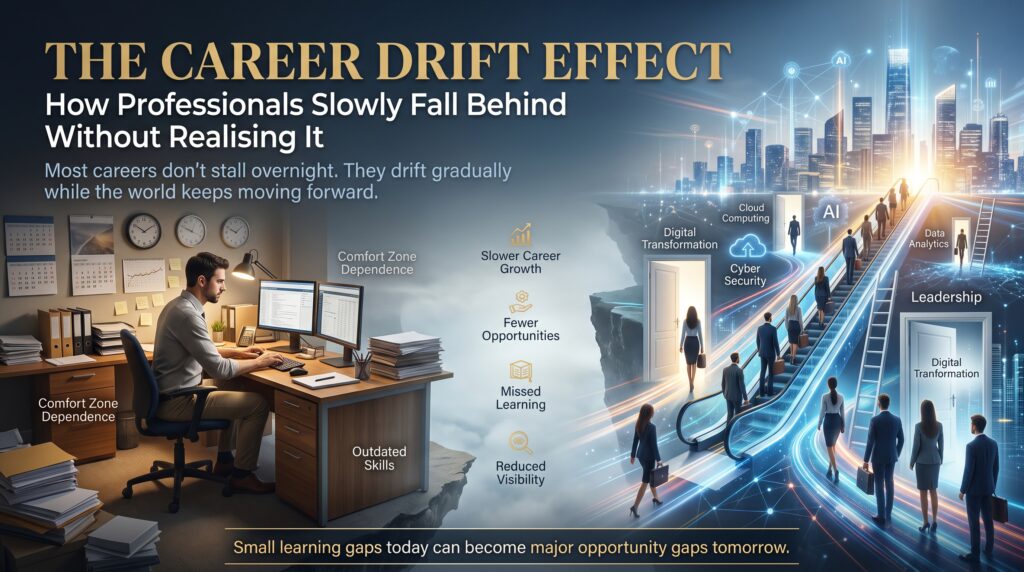

Career drift is what happens when your job title stays the same while the skills the market wants keep moving. Nobody sends a memo about it. There’s no redundancy notice, no bad performance review, no dramatic moment. You just look up one day and notice that the people getting shortlisted for the interesting roles use tools you’ve never opened, and talk about things you’ve only half-followed in meetings.
If that sounds uncomfortably familiar, you’re in good company. The career drift effect catches capable, hard-working professionals in Sydney, Melbourne, Brisbane, Perth, Adelaide and Canberra every year, precisely because it feels like nothing is wrong. This guide explains what career drift looks like, why it’s so easy to miss, the warning signs to watch for, and a practical plan to get back on course without quitting your job.
What Is Career Drift?
Picture a boat with no anchor on a calm day. Nothing dramatic happens. You’re still afloat, the weather is fine, and you’re busy. But the current is nudging you a few centimetres at a time, and an hour later the shoreline looks different. Career drift works the same way. Your employer’s tools, your industry’s expectations and your competitors’ skills shift a little each quarter. If you aren’t deliberately moving with them, you end up somewhere you never chose.
Career drift isn’t laziness, and it isn’t a lack of ambition. It’s most common among reliable people who are so good at today’s job that they never have to learn anything new to keep doing it well. That’s the trap. Being competent right now quietly hides a shrinking value later on. HR teams sometimes call a related idea skills obsolescence; the career drift effect is simply the version you feel from the inside, the slow gap between what you can do and what the market now pays for.
Why the Career Drift Effect Is So Hard to Spot

You’re busy, so it feels like progress
A full inbox and back-to-back meetings feel productive. But busy and growing are two different things. If you’re doing the same tasks with the same tools you used three years ago, you’re running to stay in the same spot.
Your workplace shields you from the market
Inside one organisation you only see one set of systems, one way of working and one definition of good. Outside, the market may have moved to cloud-first infrastructure, automated reporting or AI-assisted workflows. You usually find out when you apply for something new, and by then the gap is already wide.
Small gaps compound quietly
Missing one new tool in a quarter barely matters. Missing a dozen over four years changes your whole profile. Like interest on a debt, small gaps grow faster than you expect, which is why the problem tends to feel sudden even though it was slow.
9 Warning Signs of Career Drift
Be honest with yourself and count how many of these sound like you.
- Job ads read like a foreign language. You scan a role you’d love and half the requirements are tools, platforms or certifications you haven’t touched.
- Your last proper training was years ago. Not a compliance module, but real, hands-on learning that stretched you.
- You’re the go-to person for the old way. Being the expert on a legacy system is valuable right up until the day it’s retired.
- Newer colleagues ask sharper questions about new tech. Graduates and juniors arrive fluent in tools you’re still reading about.
- Recruiters have stopped calling. A quiet LinkedIn inbox often means your profile no longer matches what employers search for.
- Your pay has stalled. If your salary hasn’t moved meaningfully against the cost of living, the market may be valuing your skills less than it used to.
- You dodge new tools and projects. Quietly avoiding the cloud migration, the analytics rollout or the AI pilot is classic drifting behaviour.
- Your certifications feel dated. Credentials in cyber security, cloud and networking age quickly.
- You can’t describe your value without naming your employer. If your skills only make sense inside one workplace, they may not travel well.
Ticked three or more? You’re likely experiencing career drift. Ticked five or more? Act this quarter, not next year.
Which Skills Drift the Fastest?
Every field changes, but technology skills tend to age quickest. Here are the areas where the gap usually shows up first, along with a sensible starting point for each.
- Cloud computing. Many teams that once ran everything on their own servers now rely on platforms such as AWS and Microsoft Azure. If cloud is still a mystery, the AWS Technical Essentials course covers core services, pricing and security.
- Cyber security. Threats evolve constantly, and the Australian Cyber Security Centre publishes guidance that shows how quickly the landscape moves. A Cyber Security course helps you keep pace, whether you work in IT or simply handle sensitive information.
- Data and databases. Almost every role now touches data. SQL Database Training is one of the quickest ways to add a skill that employers in every industry recognise.
- Artificial intelligence. AI tools have moved from novelty to daily workflow in many offices. The Artificial Intelligence (AI) Essentials course covers core concepts, models and ethics, so you can use AI with confidence instead of anxiety.
- Networks underpin everything above. CCNA Certification Training is a well-known pathway if you want to deepen your infrastructure skills.
If you’re closer to the business side, the Business Analyst Certification, the Brand Management Course and the Web Development Course are worth a look. For a wider, independent view of which occupations and skills are in demand across the country, Jobs and Skills Australia is a good place to start.
Career Drift Across Australian Cities
Where you work shapes how career drift shows up. These are general patterns rather than guarantees, so always check current job listings in your own city.
- Sydney: finance, consulting and tech employers move fast and expect current cloud and security skills. See IT courses in Sydney.
- Melbourne: a broad mix of tech, health, education and professional services means data and digital skills carry weight across sectors. See IT courses in Melbourne.
- Brisbane: a growing technology and infrastructure scene rewards professionals who keep their skills fresh. See IT courses in Brisbane.
- Perth: resources and energy businesses keep digitising operations, so data, cloud and cyber security skills are increasingly valuable. See IT courses in Perth.
- Adelaide: defence, advanced manufacturing and digital industries all lean on up-to-date technical capability. See IT courses in Adelaide.
- Canberra: government and the public sector put a premium on cyber security, data and project skills. See IT courses in Canberra.
Live online and in-house options are available for several cities, so where you live doesn’t have to limit what you learn. You can see every option on the IT courses locations page.
A Simple 30-60-90 Day Plan to Reverse Career Drift
Days 1 to 30: get an honest picture
Save ten job ads for the role you want next. Highlight every skill you can’t confidently claim, then rank them by how often they appear. That list is your personal map of the gap. Then ask a manager, mentor or trusted colleague what skills they see rising in your field.
Days 31 to 60: pick one skill and start
Resist the urge to fix everything at once. Choose the single skill that appears most often and would make the biggest difference, then book a course with a start date. Putting a date in your diary turns a vague intention into a commitment.
Days 61 to 90: use it where people can see it
Apply your new skill to a real task at work, even a small one. Update your CV and LinkedIn profile, and be ready to talk about what you built or improved. Then repeat the cycle every year. Think of it as a regular service for your career, the way you’d service a car before it breaks down.
Why Short Courses Work Well Against Career Drift
Long degrees suit some goals, but for correcting career drift they can be slow and expensive. Short, practical courses fit the problem better: they focus on one skill, they’re hands-on, and you can apply what you learn within weeks.
At IT Courses, learners can choose weekday, evening and weekend schedules, plus live virtual classes, so study fits around work rather than competing with it. Courses include hands-on labs, real-world projects and mock tests, with trainer support and career guidance such as resume and interview preparation. You can browse the full range on the courses page, read more about us, or talk to the team about which course suits your situation.
Common Mistakes When Fixing Career Drift
- Waiting for the perfect time. There isn’t one. Starting small this month beats starting big next year.
- Learning everything at once. Spreading yourself across five topics usually means finishing none. Pick one.
- Collecting certificates without using the skills. Employers care about what you can do, so apply each new skill to real work.
- Chasing trends instead of fit. A hot topic is only useful if it connects to the role you want.
- Going it alone. Feedback from trainers, peers and managers speeds up progress and keeps you accountable.
Career Drift FAQs
What is career drift?
Career drift is the slow, often unnoticed gap that opens when your skills stay still while your industry changes. You can be performing well in your current job and still be drifting away from what the wider market wants.
How do I know if I’m experiencing career drift?
Common signs include job ads you can’t match, stalled pay, fewer recruiter messages and avoiding new tools at work. If three or more of the warning signs above sound familiar, it’s worth acting.
Can I fix career drift without changing jobs?
Yes. Many people correct career drift while staying in the same role by learning a relevant skill and applying it at work. A new skill often opens doors internally before you ever need to look elsewhere.
Which IT course is best for getting back on track?
It depends on your role and goals. Cloud, cyber security, data, networking and AI are common starting points, and the courses page lets you compare options. If you’re unsure, the team can help you choose.
How long does recovery take?
Most people notice progress within a few months of consistent learning, but it varies with how far you’ve drifted and how much time you can commit. Short, focused courses help you see results sooner.
Do I need an IT background to start?
No. Many courses begin with foundational concepts and are suitable for beginners, students and career changers.
Take the First Step Against Career Drift Today
Career drift is slow, but it isn’t permanent. The same quiet momentum that pushed you off course works in your favour once you start moving the other way. One skill, one course and one real project can change how the market sees you.
Ready to get moving? Explore the IT courses available across Australia, or call 1300 649 299 and get in touch online to talk through your options. Whether you’re in Sydney, Melbourne, Brisbane, Perth, Adelaide or Canberra, there’s a learning path that fits around your work.