


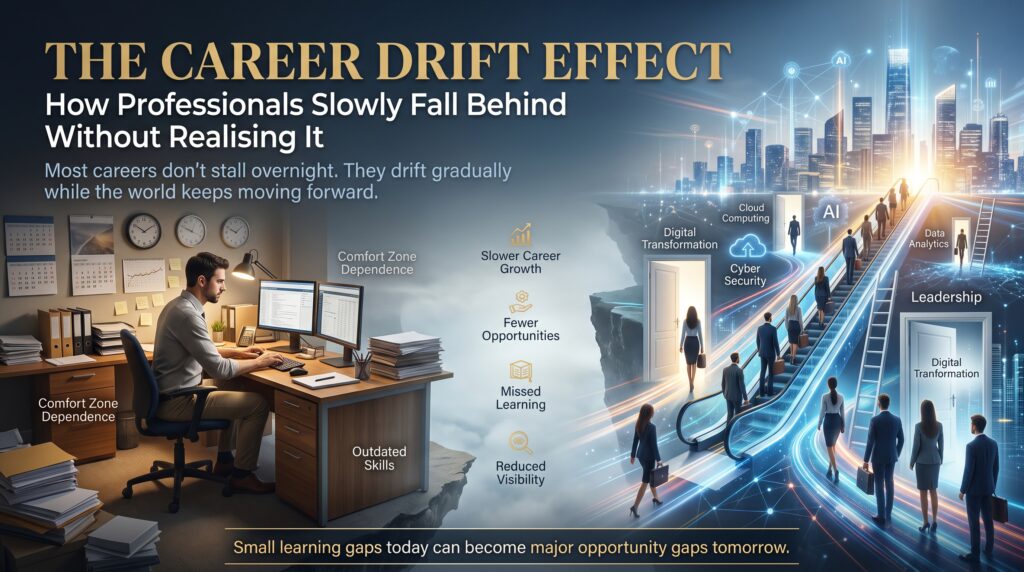
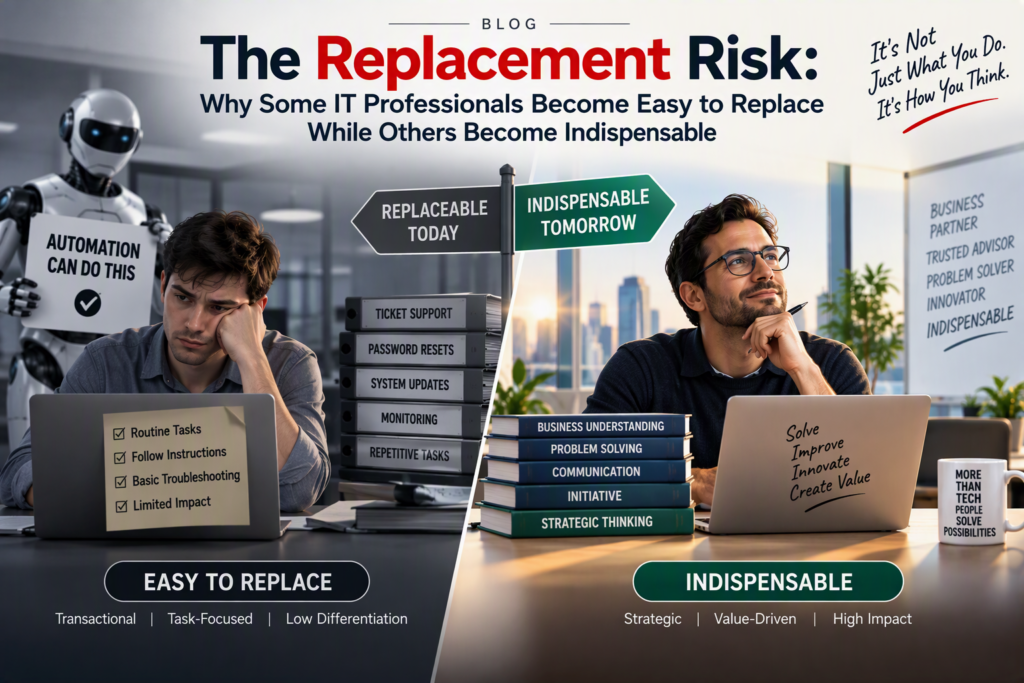
IT replacement risk is the quiet question almost every tech worker asks at some point: if my manager had to swap me out next month, how hard would that actually be? For some people the honest answer is “very easy”. For others it is “we would lose momentum for half a year”. The gap between those two answers rarely comes down to intelligence, and it is not always about years of experience either. It comes down to how you work, what you can prove, and whether your skills are gaining value or quietly losing it.
That matters more in Australia right now than it did five years ago. Generative AI is absorbing routine tasks, offshore delivery is a permanent fixture of many service desks, and businesses in Sydney, Melbourne and Brisbane are trimming teams while still hunting for people who can solve expensive problems. In other words, the market is not shrinking. It is sorting. This guide explains why some IT professionals end up easy to replace, what the indispensable ones do differently, and how you can lower your own IT replacement risk with practical steps and the right certifications.
What Is IT Replacement Risk (and Why It Matters in 2026)?
IT replacement risk is the likelihood that your role, or the specific work you do inside it, can be taken over by another person, a cheaper vendor, or a piece of software without the business feeling much pain. It is not a prediction that you will lose your job. It is a measure of how much the organisation would miss you if you were gone.
Think of it as a spectrum. At one end sits the person whose work is fully documented, repeatable and tool-specific. A capable newcomer, a managed service provider or an AI assistant could pick it up within weeks. At the other end sits the person who understands why the systems are built the way they are, who the stakeholders are, and which fixes will break which processes. Replacing them takes months and costs real money.
The World Economic Forum Future of Jobs Report and workforce analysis from Jobs and Skills Australia both point in the same direction: technology roles are being reshaped rather than erased, and demand is shifting toward cloud, cyber security, data and the ability to combine technical depth with business judgement. Your IT replacement risk depends on which side of that shift your daily work sits on.
5 Signs Your IT Replacement Risk Is High
Be honest with yourself as you read this list. Most people recognise at least one or two.
1. Your value is tied to a single tool or vendor
If everything you know lives inside one legacy platform, one ticketing system or one version of one product, you are exposed the moment the business migrates, consolidates or outsources. Tool knowledge is useful, but on its own it pushes your IT replacement risk up, because it is the easiest thing in IT to replace. Employers can train it, buy it or automate it.
2. You close tickets but never change the system
Resolving the same password reset, the same print queue issue and the same access request every week keeps the lights on, and that is genuinely important. But if you never ask why the ticket keeps coming back, you are doing work that a script, a chatbot or a lower-cost team can take on. Professionals with a low IT replacement risk are the ones who remove the cause, not just the symptom.
3. Nobody outside IT knows what you do
Invisible work is easy to cut. If your manager cannot describe your impact in one sentence, and finance or operations leaders have never heard your name, your position depends entirely on goodwill. Visibility is not self-promotion, and it is one of the cheapest ways to cut your IT replacement risk. It is making the value of your work legible to the people who approve budgets.
4. Your skills stopped moving two or three years ago
Cloud platforms such as Microsoft Azure and AWS, security frameworks, and data tooling change every quarter. A certification you earned in 2019 and never refreshed tells the market you stopped at 2019. Skill stagnation is the single most controllable driver of IT replacement risk, and it is the one people ignore longest.
5. You cannot explain your work in business terms
“I patched 40 servers” is a task. “I closed a vulnerability that could have interrupted payroll for 800 staff” is an outcome. If you only speak in tasks, you will be treated like a cost. If you speak in risk, revenue and time saved, you will be treated like an investment.
What Makes an IT Professional Indispensable?
Indispensable does not mean irreplaceable in some dramatic, hero-in-the-server-room sense. It means the business would clearly be worse off without you, and would struggle to rebuild what you bring. In practice, the professionals who keep their IT replacement risk low tend to share five habits.
They own outcomes, not just tasks
Someone with an ownership mindset does not stop at “I did what the ticket said”. They check that the fix worked, that the user can actually do their job, and that the same problem will not return next month. Managers notice this quickly, because it removes work from their own plate, and it steadily lowers your IT replacement risk.
They connect technology to money, risk and time
A cloud engineer who can say “moving this workload to Azure cuts our hosting bill and shortens recovery time from a day to an hour” is having a very different conversation from one who says “I migrated the VM”. The first person is helping the business decide. The second is executing a decision someone else made.
They hold context that is hard to copy
Documentation can be handed over. Judgement cannot. Knowing which vendor always misses deadlines, which department will resist a change, and which “temporary” workaround is actually holding up a critical process is institutional knowledge that takes years to rebuild. Smart professionals build this context deliberately, and then share enough of it to be trusted without giving away their edge.
They make other people better
Mentoring juniors, writing clear runbooks and running short knowledge sessions may look like extra effort, but they turn one good engineer into a stronger team. Leaders protect people who multiply the output of others, which is another reason their IT replacement risk stays low.
They keep learning on purpose
The indispensable ones do not wait for a training budget or a bad performance review. They pick a direction, such as cloud, cyber security, networking or data, and build proof through certifications and real projects. That habit alone can move someone from replaceable to promotable within a year.
Easy to Replace vs Indispensable: A Side-by-Side View
| Area | Higher IT replacement risk | Lower IT replacement risk |
| Skill base | One tool or one vendor | Core concepts plus two or three platforms |
| Daily focus | Closing tickets and following scripts | Removing root causes and improving systems |
| Communication | Technical jargon only | Explains impact in risk, cost and time |
| Visibility | Known only by the immediate team | Trusted by managers and business stakeholders |
| Learning | Trains when told to | Holds current certifications and projects |
| AI tools | Avoids or fears them | Uses them to deliver faster and takes on higher-value work |
How AI Changes IT Replacement Risk
AI does not replace IT professionals wholesale. It replaces tasks, and it does so unevenly. First-draft scripts, log summaries, knowledge base articles and basic troubleshooting steps are now quick for an AI assistant to produce. That puts pressure on roles built almost entirely on those tasks.
What AI cannot do well is take accountability, weigh trade-offs inside a specific organisation, negotiate with a vendor, or explain a failure to a board. Those responsibilities are moving toward people who understand architecture, security and governance. Vendors such as Microsoft Learn and security frameworks from NIST are already building learning paths around AI-assisted work, which tells you where the industry expects skills to go.
The practical takeaway is simple. Learn to use AI tools well, and pair them with a deeper skill that AI depends on humans to supervise. A professional who can direct AI, check its output and secure the environment it runs in has a much lower IT replacement risk than one who competes with it on speed.
Certifications and Skills That Lower Your IT Replacement Risk
Certifications are not magic, and nobody should pretend a badge alone makes you indispensable. But they do three useful things: they give you a structured way to fill gaps, they signal current knowledge to recruiters, and they open doors to roles that filter on credentials. Here is how the main pathways line up.
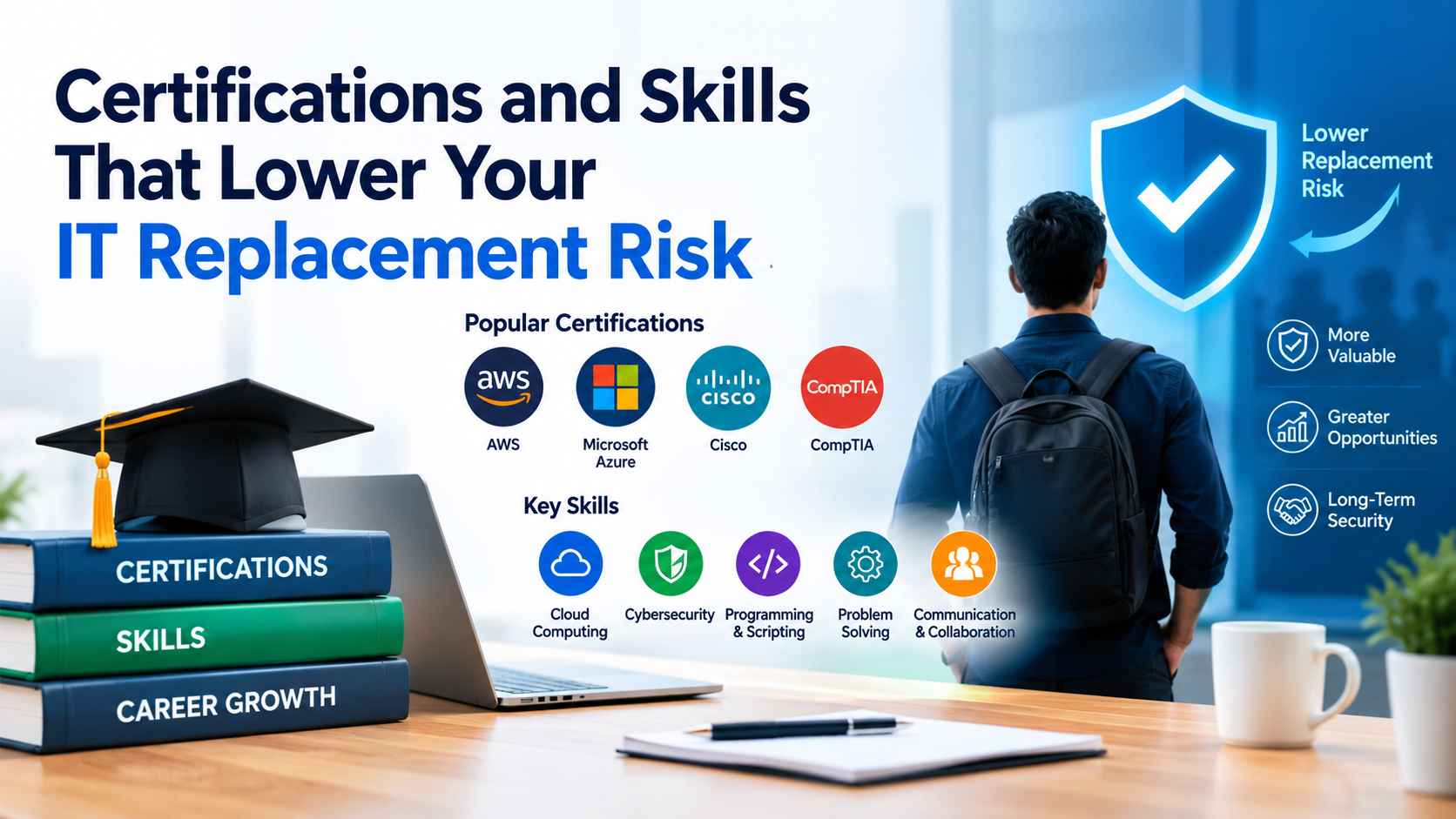
| Career direction | Skills that reduce replacement risk | Where to start |
| Cloud and infrastructure | Azure or AWS fundamentals, identity, cost control, automation | Azure certifications and AZ-900 fundamentals |
| Cyber security | Threat detection, risk assessment, compliance, incident response | Cyber security certifications |
| Networking | Routing, switching, network automation, troubleshooting | CCNA certification |
| Data and analytics | Data modelling, dashboards, storytelling with data | Data analytics courses and Power BI course |
| Delivery and leadership | Project delivery, agile ways of working, stakeholder management | Project management certifications and Scrum Master certification |
| Quality and testing | Test strategy, automation, defect analysis | Software testing course |
If you are not sure which lane fits, start with the IT courses hub and compare options, or speak to the team at Logitrain about a pathway based on your current role. Choosing one direction and going deep beats collecting five entry-level certificates in five different areas when your goal is to reduce IT replacement risk.
IT Replacement Risk Across Australian Cities
Local demand shapes which skills protect you. The picture below is a general guide to where employers are hiring and what they tend to prioritise, so use it as a starting point rather than a promise.
| City | What employers commonly look for | Useful pathways |
| Sydney | Cloud, cyber security and data roles in finance, consulting and enterprise | Azure, Cyber security, Data analytics |
| Melbourne | Cloud migration, analytics, software delivery and health tech | Azure, Power BI, Scrum Master |
| Brisbane | Managed services, infrastructure and growing cloud teams | CCNA, AZ-900 |
| Perth | Resources, energy and operational technology support | Networking, Cyber security |
| Adelaide | Defence, advanced manufacturing and public sector projects | Cyber security, Project management |
| Canberra | Government, compliance and security-cleared work | Cyber security, Project management |
Whichever city you work in, remote and hybrid roles mean you are now competing with people well beyond your postcode. That makes a visible, current skill set even more valuable for managing your IT replacement risk.
A 90-Day Plan to Reduce Your IT Replacement Risk
You do not need a dramatic career reset. You need a few deliberate moves, repeated consistently.
- Days 1 to 15: Audit yourself. List your tasks for a typical fortnight. Circle the ones a script, an AI assistant or a junior could do. Circle the ones that need judgement. Your goal is to spend more time on the second group.
- Days 16 to 30: Pick one direction. Choose cloud, security, networking, data or delivery. Read the exam objectives for the entry certification and note the gaps.
- Days 31 to 60: Study and build. Enrol in a structured course, then build one small project you can show, such as a monitored cloud environment, a hardened test network or a dashboard that solves a real reporting problem.
- Days 61 to 75: Fix one recurring problem at work. Pick the ticket type that never dies. Diagnose the cause, propose a fix, and write down the hours saved.
- Days 76 to 90: Make it visible. Share the outcome with your manager in one page or one short meeting. Ask what the next most valuable problem is, and offer to own it.
Frequently Asked Questions About IT Replacement Risk
Will AI replace IT professionals in Australia?
AI is more likely to change IT jobs than remove them. Routine, repeatable tasks are the most exposed. Roles that involve architecture, security judgement, stakeholder communication and accountability are growing in importance.
Which IT skills are hardest to replace?
Cloud architecture, cyber security, network design, data analysis and technical project leadership are consistently hard to replace because they combine technical depth with business decisions.
How do I stop being easy to replace at work?
Own outcomes instead of tasks, communicate your impact in business terms, keep your certifications current and make your work visible to decision-makers. Small, repeated actions matter more than one big push when you are working on IT replacement risk.
Are IT certifications worth it if I already have experience?
Yes, when they are chosen with purpose. A current certification shows you have kept pace with the platform, and it can unlock higher-paying roles that filter by credential. Experience plus a relevant certificate is a stronger combination than either alone.
Can I reduce my IT replacement risk while working full time?
Absolutely. Live online classes, evening sessions and short focused courses are designed for working professionals. Even three to four hours a week over a few months can noticeably reduce your IT replacement risk.
Final Thoughts: Choose to Be Hard to Replace
Nobody can remove every IT replacement risk, and no certificate guarantees a job. But you can decide whether you are drifting or building. The professionals who stay valuable are not always the smartest in the room. They are the ones who keep learning, keep solving the real problem, and make sure the right people can see it.
Ready to take the next step? Explore the IT courses at itcourses.au, compare pathways in cloud, cyber security and networking, or talk to the Logitrain team about a plan that fits your career and your city.