


The AI apprenticeship gap is the uncomfortable question hanging over every graduate and career changer entering technology right now. For decades, junior IT staff learned by doing the small, repetitive jobs: closing simple tickets, writing basic scripts, running test cases, documenting systems. Today, AI tools can do much of that work in seconds. So where do beginners get the experience that turns them into senior engineers?
This guide looks at what the AI apprenticeship gap really means, why it is not the end of entry-level IT careers, and what juniors and employers can do about it. If you are planning your first move into technology in Australia, the practical steps below, along with training from IT Courses Australia, should help you build real experience even when the traditional beginner tasks are shrinking.
What Is the AI Apprenticeship Gap?
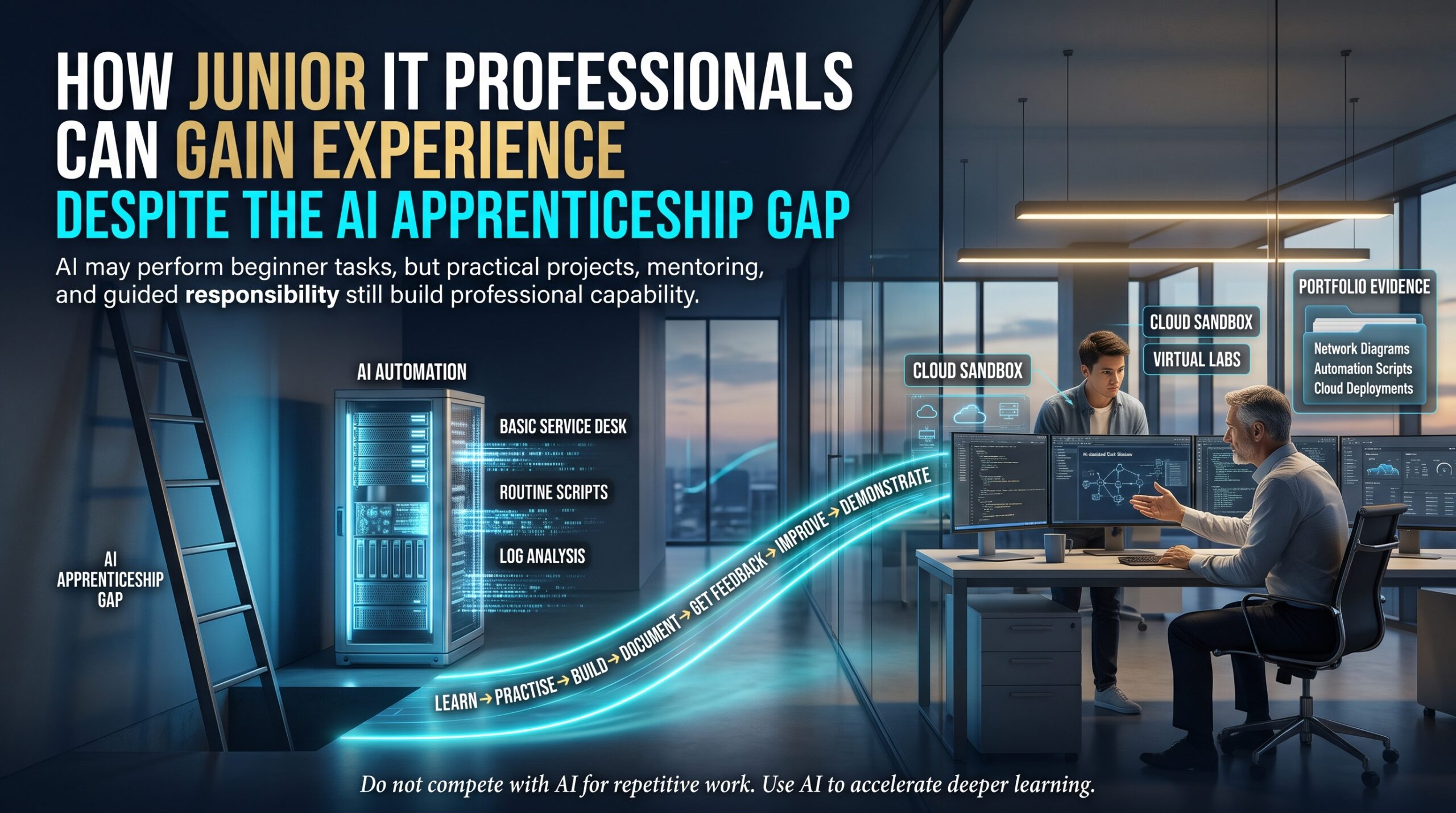
The AI apprenticeship gap describes the shrinking supply of low-risk, entry-level tasks that once trained new IT workers. Apprenticeship in tech has always been informal. You started with the easy work, made small mistakes where they were cheap, and gradually earned harder problems. If AI takes the easy work, the bottom rung of the ladder gets thinner.
It is worth being honest here. Nobody knows exactly how this will play out, and anyone promising certainty is guessing. What we can say is that the shape of beginner work is changing, and juniors who understand the change will be better placed than those who ignore it.
Which Beginner IT Tasks Is AI Taking Over?
AI tools are already useful for a long list of starter tasks. Examples include drafting boilerplate code, suggesting SQL queries, summarising support tickets, writing first-pass documentation, generating test cases and explaining error messages. These used to take a junior hours of research. Now a prompt can produce a decent first draft.
The key word is draft. AI output still needs someone to check it, test it, understand it and take responsibility for it. That checking step is where human experience matters, and it is the part that tends to be missing when a beginner has never done the underlying work by hand.
Why the AI Apprenticeship Gap Matters for Career Changers in Australia
Entry-level job ads in Sydney, Melbourne and Brisbane already attract large numbers of applicants. If employers believe AI can cover basic tasks, some may ask for more experience upfront, which feels unfair to someone who has not yet had a chance to gain any. Canberra, Perth and Adelaide face a similar tension, especially in government and professional services roles where accountability and security standards are high.
Career changers feel this most. You may have strong workplace skills from another field, but you need a way to show technical proof. That is why the AI apprenticeship gap is less about whether jobs exist and more about how beginners demonstrate they can be trusted with real work.
How Junior IT Professionals Can Gain Experience Despite the AI Apprenticeship Gap
The good news is that experience does not only come from paid tickets. Here are seven ways to build it deliberately.
1. Learn the fundamentals before you lean on AI
If you cannot read a query, trace a network issue or understand a security alert yourself, you cannot judge whether an AI answer is right. Foundational courses in SQL database training, networking with CCNA and cloud basics with AWS Technical Essentials give you the mental models that make AI useful instead of risky.
2. Treat AI as a supervised teammate
Use AI for first drafts, then review everything line by line. Ask it to explain its reasoning. Break things on purpose and fix them. Over time, you build the judgement that employers actually want, and you can say in interviews that you know how to verify AI output.
3. Build a home lab and real projects
Spin up a free-tier cloud environment, deploy a small website, secure a virtual machine or build a dashboard from a public dataset. Document each step in a short write-up. Projects show initiative, and they replace the beginner tickets you might not get at work.
4. Earn recognised certifications
Certifications give recruiters a quick, comparable signal. Depending on your direction, consider a cyber security course, web development training or a business analyst certification. Pair each with a project so the certificate has evidence behind it.
5. Learn how AI works, not only how to use it
Understanding models, data, limitations and ethics makes you more valuable than someone who only types prompts. An Artificial Intelligence (AI) Essentials course is a practical starting point for beginners.
6. Look for apprenticeships, traineeships and internships
Formal pathways still exist. The Australian Government explains options on the Australian Apprenticeships website, and some training providers offer structured internships or work-experience pathways alongside study. Ask about these before you enrol.
7. Build relationships and ask for shadowing
Join local meetups in your city, contribute to open-source documentation, and ask senior professionals if you can observe how they troubleshoot. A mentor can pass on judgement that no tool can.
Beginner Work vs Future Skills in the AI Apprenticeship Gap
The table below shows how some classic junior tasks are shifting and what skills help you stay valuable. It is a guide to current trends, not a prediction.
| Classic junior task | How AI is changing it | Skill to build instead | Explore |
| Closing simple support tickets | AI drafts replies and triages queues | Troubleshooting logic, networking basics | CCNA Training |
| Writing basic SQL queries | AI suggests queries instantly | Data modelling, query checking, performance | SQL Database Training |
| Boilerplate web code | AI generates starter code | Code review, debugging, responsive design | Web Development |
| Basic cloud setup | Templates and assistants speed it up | Architecture, cost and security awareness | AWS Technical Essentials |
| Reviewing security alerts | AI summarises and prioritises alerts | Threat understanding, incident response | Cyber Security Course |
| Documenting requirements | AI drafts user stories and notes | Stakeholder questions, analysis, validation | Business Analyst Certification |
| Using AI tools casually | Everyone can prompt | Understanding models, risks and ethics | AI Essentials |
The pattern is clear. Doing the task is becoming less important than understanding, checking and improving the result.
What Employers Can Do About the AI Apprenticeship Gap
This is not only a problem for juniors. If companies stop hiring beginners, they will struggle to find experienced people in five years. Smart employers are already rethinking how they grow talent.
- Create structured rotations so juniors touch support, testing, cloud and security under supervision.
- Pair juniors with seniors and make AI review a shared learning exercise.
- Give juniors real, low-risk ownership of small internal tools, documentation or monitoring tasks.
- Use AI to speed up training, not only to cut headcount, for example by generating practice scenarios.
- Partner with training providers for internships and work-experience placements.
IT Training Options Across Sydney, Melbourne, Brisbane, Perth, Adelaide and Canberra
You do not need to move cities to build skills. Courses run online, live virtual and in the classroom. Explore local options for Sydney, Melbourne, Brisbane, Perth, Adelaide and Canberra, or view the full locations page. Learners on the Gold Coast, in Hobart and in Darwin can often study online.
You can compare every option on the IT courses page, read answers on our IT course FAQs or learn about us. For a wider catalogue, Logitrain lists its online IT courses, including a cybersecurity course, and explains its job-ready IT programs. For labour market information, see Jobs and Skills Australia and Workforce Australia.
Frequently Asked Questions About the AI Apprenticeship Gap
What is the AI apprenticeship gap?
It is the shrinking set of beginner tasks that once helped new IT professionals learn on the job, now that AI can handle many of them. It raises the question of how juniors gain hands-on experience.
Will AI replace junior IT jobs?
Nobody can say for certain. Many entry-level tasks are changing, but organisations still need people who can verify, secure and manage systems. Juniors who combine fundamentals with AI skills are likely to stay relevant.
How can I get IT experience without a job?
Build projects in a home lab, earn certifications, contribute to open-source documentation, seek internships or traineeships, and document your work in a simple portfolio.
Which IT courses are best for beginners in the age of AI?
Foundational courses in SQL, cloud, networking and web development, plus an AI essentials course, give beginners both core skills and AI literacy. Your best choice depends on the role you are aiming for.
Do employers still hire entry-level IT staff in Australia?
Yes, though requirements vary by employer, industry and city. Check live job ads and speak with a course adviser about realistic pathways for your background.
Final Thoughts: Closing the AI Apprenticeship Gap Is a Shared Job
The AI apprenticeship gap is real, but it is not a dead end. Beginners who learn the fundamentals, practise with AI under supervision, build visible projects and earn credible certifications can still become strong professionals. Employers who keep investing in juniors will have the deepest talent bench when everyone else is scrambling.
If you want help choosing a starting point, contact our team or call 1300 649 299. An adviser can talk through your background and suggest a practical pathway.