

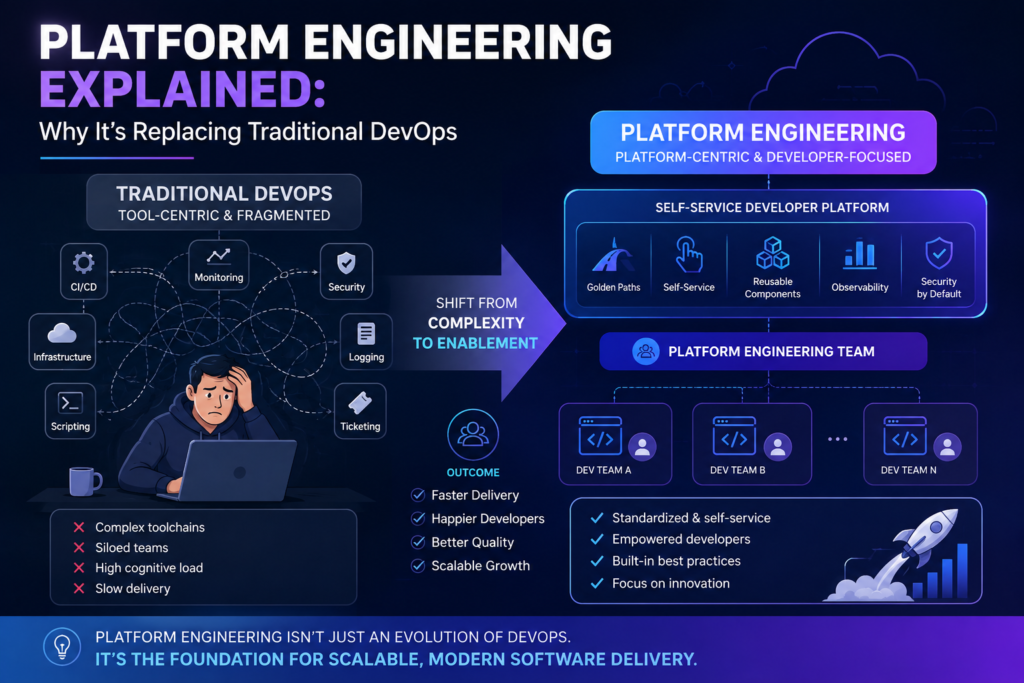


Platform engineering is quickly becoming the default operating model for software delivery teams across Australia, and it’s changing how organisations in Sydney, Melbourne, Brisbane, Perth, Adelaide and Canberra think about DevOps. If your team is drowning in tickets, tool sprawl and inconsistent deployment pipelines, platform engineering offers a structured way out. This guide breaks down what platform engineering actually is, how it compares to traditional DevOps, why so many Australian employers are hiring for it, and how you can build the skills to move into this fast-growing career path.
What Is Platform Engineering?
Platform engineering is the discipline of designing and building self-service internal developer platforms (IDPs) that give software teams standardised, golden-path tooling for deployment, infrastructure and monitoring. Instead of every engineering team reinventing its own CI/CD pipeline, platform engineering teams build a shared platform often using tools such as Kubernetes, Terraform, Docker and Backstage that developers can use without needing deep infrastructure knowledge. The goal of platform engineering is to reduce cognitive load on developers while improving consistency, security and speed across the organisation.
Platform Engineering vs Traditional DevOps: Key Differences
While DevOps is a culture and set of practices for breaking down silos between development and operations, platform engineering is a concrete implementation of those principles, delivered as an internal product. The table below summarises how platform engineering differs from traditional DevOps in practice.
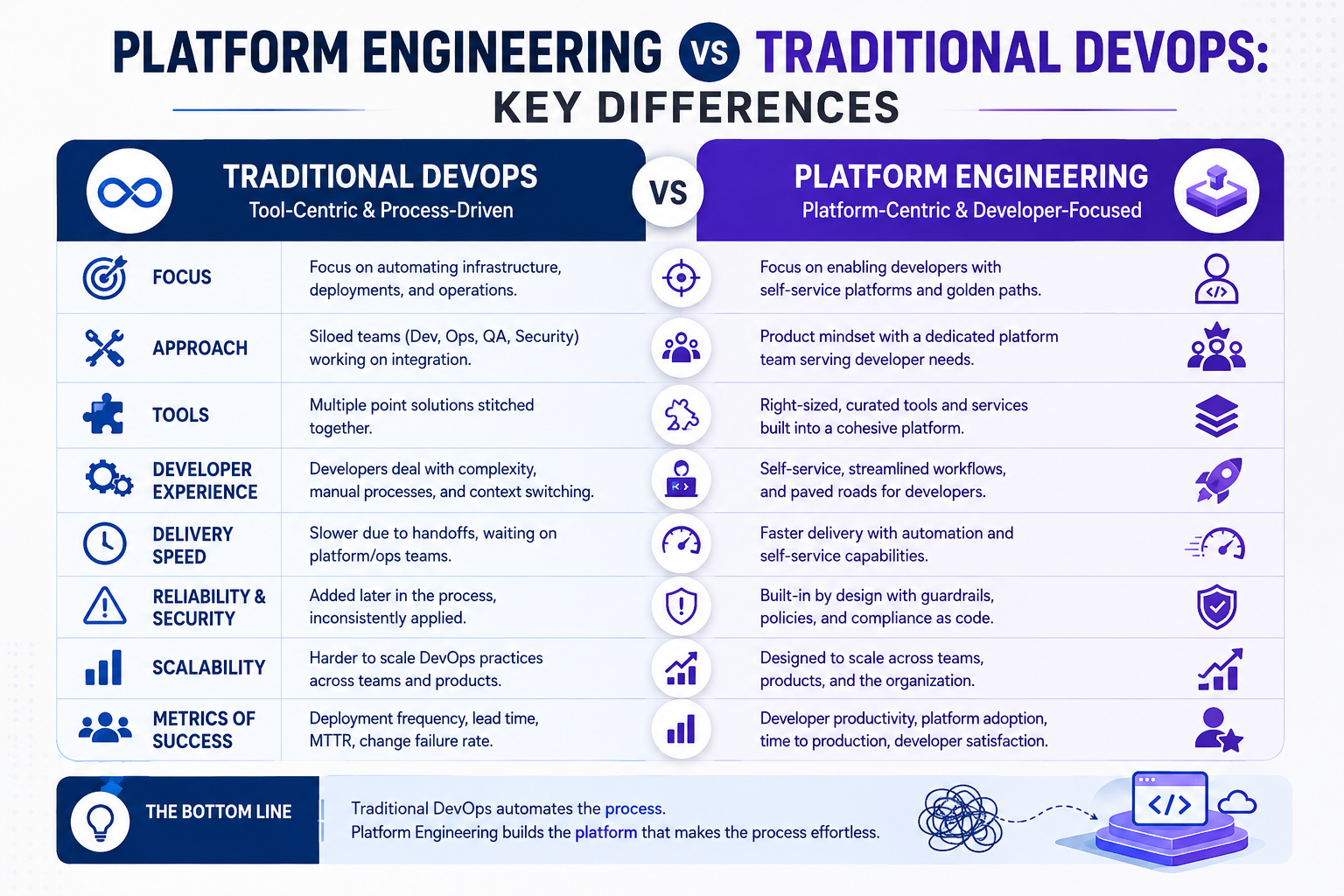
| Aspect | Traditional DevOps | Platform Engineering |
| Core focus | Culture & collaboration between dev and ops | A self-service product (the platform) built for developers |
| Ownership | Shared responsibility, often ad-hoc | Dedicated platform team with a product roadmap |
| Tooling | Each team configures its own CI/CD and infra | Standardised golden paths via an internal developer platform |
| Developer experience | Developers manage infrastructure directly | Developers self-serve through the platform, minimal ops overhead |
| Metrics | Deployment frequency, MTTR | Platform adoption, developer experience (DevEx), lead time |
Why Platform Engineering Is Replacing Traditional DevOps in Australia
Australian enterprises and mid-market businesses are adopting platform engineering for three main reasons. First, DevOps teams have become bottlenecks — as organisations scale, a small ops team can no longer support every product team individually, so platform engineering shifts routine infrastructure work into reusable, self-service tooling. Second, cloud costs and security requirements have increased pressure to standardise: a well-designed platform enforces guardrails automatically, rather than relying on every developer following best practice manually. Third, hiring data shows demand shifting: job boards increasingly list “Platform Engineer” and “Site Reliability Engineer” roles instead of generic “DevOps Engineer” positions in Sydney, Melbourne and Brisbane, reflecting how employers now expect platform-level thinking rather than isolated scripting and pipeline maintenance. According to industry research including the
Gartner and Puppet State of DevOps reports, platform engineering adoption has grown sharply as organisations look to reduce developer toil and improve delivery speed at scale, and the Cloud Native Computing Foundation (CNCF) now tracks platform engineering as one of the fastest-growing categories in the cloud-native ecosystem.
Core Skills You Need for a Platform Engineering Career
Moving into platform engineering means combining traditional DevOps fundamentals with product-thinking and platform-specific tooling. The most in-demand skills for platform engineering roles in Australia include:
- Cloud infrastructure: Microsoft Azure, AWS or Google Cloud Platform
- Container orchestration with Kubernetes and Docker
- Infrastructure as Code (Terraform, Bicep, ARM templates)
- CI/CD pipeline design and GitOps workflows (ArgoCD, GitHub Actions)
- Internal developer platform tools such as Backstage
- Observability and monitoring (Prometheus, Grafana, Datadog)
- Security and identity fundamentals for cloud environments
- Product and stakeholder management, since platform teams treat the platform as an internal product
Platform Engineering Salaries in Australia by City (2026)
Platform engineering salaries in Australia sit above traditional DevOps roles in most capital cities, reflecting the additional cloud architecture and product skills required. Indicative annual salary ranges based on current advertised roles are shown below.
| City | Platform Engineer (AUD) | Traditional DevOps Engineer (AUD) |
| Sydney | $140,000 – $190,000 | $120,000 – $160,000 |
| Melbourne | $135,000 – $185,000 | $115,000 – $155,000 |
| Brisbane | $125,000 – $170,000 | $110,000 – $145,000 |
| Perth | $125,000 – $165,000 | $105,000 – $140,000 |
| Adelaide | $115,000 – $155,000 | $100,000 – $135,000 |
| Canberra | $130,000 – $175,000 | $115,000 – $150,000 |
Note: figures are indicative market ranges and vary by seniority, industry and employer.
Best Certifications and Courses to Start Your Platform Engineering Career
The fastest way to move into platform engineering is to build cloud, containerisation and automation skills through structured, instructor-led training. LogitrainIT courses cover the full platform engineering stack, and pair well with certification pathways such as Microsoft Azure certifications for cloud infrastructure, cloud and Kubernetes training for container orchestration, and cyber security certifications for the security fundamentals every platform team needs. Learners across Sydney, Melbourne, Brisbane, Perth, Adelaide and Canberra can complete these courses through Logitrain, either in a classroom or live online, making platform engineering training accessible no matter which city you’re based in.
How to Transition from DevOps to Platform Engineering
If you’re already working in a DevOps role, the transition into platform engineering is achievable within 6–12 months. Start by deepening your Kubernetes and Infrastructure as Code skills, then get hands-on with an internal developer platform tool like Backstage to understand how platform teams package golden paths for other developers. Look for opportunities within your current organisation to formalise ad-hoc tooling into reusable, self-service platforms this is the core mindset shift platform engineering requires. Pairing practical project work with a recognised certification pathway, such as those offered through Logitrain’s IT courses, gives hiring managers confidence that you understand both the tools and the product-thinking behind platform engineering.
Frequently Asked Questions
Is platform engineering the same as DevOps?
No. DevOps is a broader culture and set of practices, while platform engineering is a specific implementation of DevOps principles delivered as a self-service internal product.
Do I need to know Kubernetes for platform engineering?
Kubernetes is one of the most common tools used in platform engineering, particularly for container orchestration, but the discipline also relies heavily on Infrastructure as Code, CI/CD and internal developer platform tools such as Backstage.
Is platform engineering in demand in Australia?
Yes. Job listings for platform engineering and related site reliability roles have increased across Sydney, Melbourne, Brisbane, Perth, Adelaide and Canberra as organisations move away from ad-hoc DevOps setups toward standardised platforms.
What salary can a platform engineer expect in Australia?
Platform engineering salaries in Australia typically range from around $115,000 in Adelaide to over $190,000 in Sydney for experienced roles, generally sitting above equivalent traditional DevOps positions.
Final Thoughts
Platform engineering isn’t replacing DevOps culture it’s giving DevOps principles a concrete, scalable home inside an internal developer platform. For IT professionals across Australia, building platform engineering skills now, through structured training such as Logitrain IT courses, is one of the clearest ways to future-proof a career in cloud and infrastructure.